

- Scaloni to stay on as Argentina head coach until 2030 |
- Spain overtakes Germany as top EU market for Bangladeshi apparel |
- Trump sidelines Vance from Iran talks, says no need to negotiate |
- Information Commission to remain independent, neutral: CIC Nahreen |
- PM returns home from Turkiye after attending COP31 |
Spain overtakes Germany as top EU market for Bangladeshi apparel
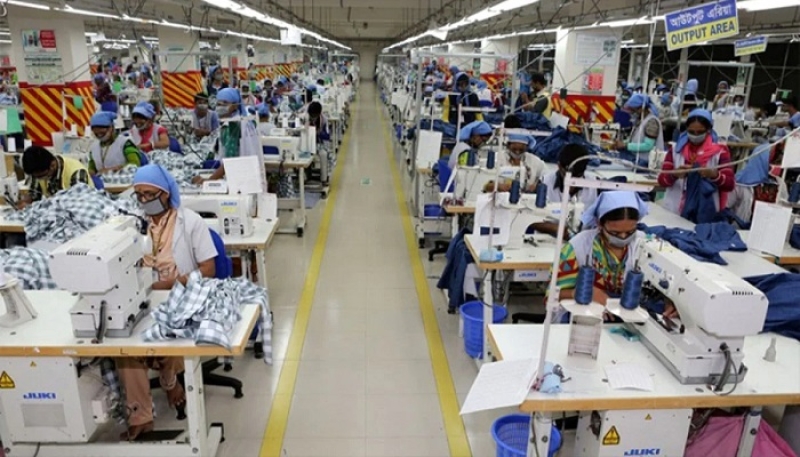
Photo: collected
Bangladesh’s ready-made garment (RMG) exports to the European Union grew 2.79 percent year-on-year to $6.43 billion during the first four months (July–October) of FY27, with Spain alone accounting for nearly 98 percent of the bloc's total export growth, according to Export Promotion Bureau (EPB) data compiled by Bangladesh Apparel Voice.
While shipments to Spain surged 13.36 percent to $1.45 billion—pushing it past Germany as Bangladesh's single largest EU apparel market—stagnation in Germany and sharp contractions in France underscore a narrow and vulnerable export recovery.
Spain accounted for nearly 98% of the bloc's total export growth, highlighting the narrow base of the recovery.
Exports to Spain increased 13.36% to $1.45 billion from $1.28 billion a year earlier. The $170.56 million increase accounted for almost the entire $174.51 million rise in Bangladesh's EU-bound garment shipments.
Spain also overtook Germany to become Bangladesh's largest apparel export destination in the EU, with a 22.51% share.
Germany, previously the top destination, recorded virtually no growth, with exports rising just 0.01% to $1.44 billion, giving it a 22.37% share.
Among other major markets, exports to the Netherlands grew 8.68% to $784.57 million, while shipments to Poland increased 2.85% to $545.91 million. In contrast, exports to France fell 7.87% to $611.10 million.
Shipments to the remaining EU markets collectively declined 1.34% to $1.60 billion. The five largest destinations accounted for around 75% of Bangladesh's total garment exports to the bloc.
In October alone, EU-bound garment exports grew just 1.10% year-on-year to $1.53 billion. Germany remained the largest destination with $315.72 million, up 0.59%, while Spain followed with $299.20 million, up 11.95%. Exports to France dropped 15.22% to $161.69 million.
Industry leaders said the modest overall growth masked underlying competitiveness challenges as European buyers increasingly explored alternative sourcing destinations ahead of Bangladesh's graduation from the least developed country (LDC) category.
Mohammad Hatem, president of the Bangladesh Knitwear Manufacturers and Exporters Association, said Bangladesh was gradually losing ground in the European market as buyers developed alternative sourcing options.
He said European buyers were increasingly building sourcing capacity in India, anticipating that the country would retain preferential market access while Bangladesh could face higher duties after LDC graduation, potentially affecting future orders.
MA Jabbar, managing director of DBL Group, identified limited product diversification as another major export constraint to the European Union.
Bangladesh remains heavily dependent on cotton-based apparel, while competitors such as China and Vietnam have stronger capabilities in man-made fibre products, allowing them to cater to a wider range of buyer demands, he said.
Greater investment in man-made fibres and product diversification is essential to strengthen the country's competitiveness, Jabbar added.
Shovon Islam, managing director and owner of Sparrow Group, said Bangladesh must secure competitive trade arrangements and prepare for stricter EU due diligence and supply-chain traceability requirements to retain its market position.
He warned that uncertainty over post-LDC market access could prompt buyers to diversify sourcing, while high borrowing costs, limited access to capital and rising energy prices were further undermining manufacturers' competitiveness.
The latest figures show that gains in Spain and the Netherlands are providing some support, but stagnation in Germany and declining exports to France and other markets leave the recovery vulnerable.
Sustaining growth in Europe will require better trade arrangements, product diversification and stronger compliance with evolving EU requirements, industry leaders said.
Courtesy: The Business Standard.