

- Over 150 garment factories shut in Ashulia amid labour unrest, 50 injured |
- Scaloni to stay on as Argentina head coach until 2030 |
- Spain overtakes Germany as top EU market for Bangladeshi apparel |
- Trump sidelines Vance from Iran talks, says no need to negotiate |
- Information Commission to remain independent, neutral: CIC Nahreen |
Sylhet residents breathe relatively clean air
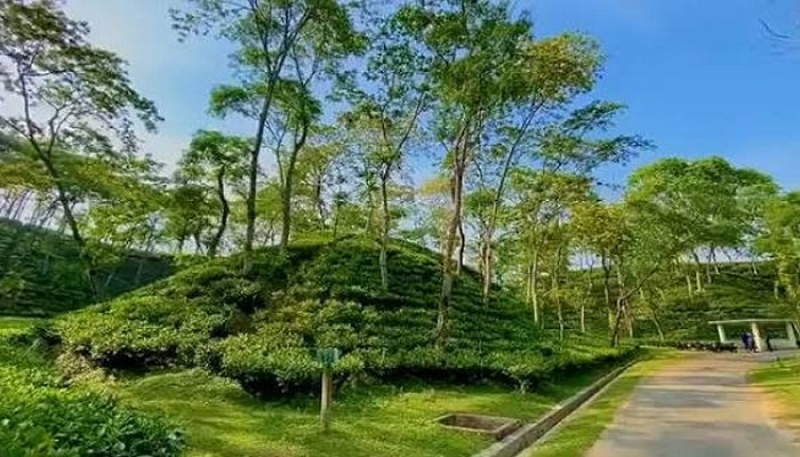
Photo: collected
Residents in the north-eastern divisional hub of Sylhet continue to breathe the cleanest air among the country’s major urban regions, according to environmental data.
Data from the IQAir Real-Time City Ranking reveals that the Air Quality Index (AQI) in Sylhet sits at a moderate level of around 81 to 86, meaning the air is generally acceptable but can pose minor health risks to unusually sensitive individuals.
The yearly average air pollution data, generated by the Department of Environment (DoE), shows Sylhet had the cleanest air among all divisional cities in 2025 with 50.32 µg/m³ (microgram/cubic metre) of PM2.5.
In contrast, Rangpur recorded the highest yearly average PM2.5 in 2025 at 105.83 µg/m³, followed by Rajshahi (90.66 µg/m³), Dhaka (89.91 µg/m³), Mymensingh (81.01 µg/m³), Chattogram (64.70 µg/m³), Khulna (63.27 µg/m³) and Barishal (56.55 µg/m³).
In Sylhet, higher annual rainfall and abundant greenery help wash particulate matter out of the atmosphere though levels still remained 1.44 times above the national limit.
Talking to BSS, DoE deputy director (air quality) Dr Mohammad Abdul Motalib said air pollution level is relatively low in Sylhet due to its geographical location and greenery.
Transboundary air pollution could not affect the atmosphere in the Sylhet region, resulting in relatively cleaner air there, he said.
A report by the World Bank also highlights that while air pollution remains a nationwide challenge, the eastern regions - specifically the Sylhet division - consistently experience the lowest levels of fine particulate matter (PM2.5) in the country.
On the other hand, the capital Dhaka and divisions like Rangpur and Rajshahi register significantly higher, more hazardous concentrations of particulate matter.
Environmentalists attribute Sylhet’s relative advantage to its unique geographic positioning, surrounded by expansive tea gardens and a hilled landscape, as well as a lower concentration of heavy industrial brick kilns compared to central Bangladesh.
However, environmental monitoring agencies caution that local air quality follows a strict seasonal pattern.
During the dry winter months from November to February, lower wind speeds and lack of rainfall typically cause atmospheric inversions, pulling dust and vehicle emissions lower to the ground and pushing regional AQI scores briefly into less favourable thresholds.
Local civic groups, including chapters of the Bangladesh Paribesh Andolon (BAPA), note that maintaining this relative advantage requires active municipal management.
Unplanned construction dust, domestic waste management, and growing vehicular traffic in the core city areas pose ongoing challenges to keeping the divisional capital’s air breathable.
The DoE has established a countrywide air quality monitoring (AQM) network.
The DoE measures the AQI based on five criteria pollutants: Particulate Matter (PM10) and (PM2.5), Nitrogen Dioxide (NO?), Carbon Monoxide (CO), Sulfur Dioxide (SO?), and Ozone (O?).
According to air quality standard set by the DoE, AQI score ranging 0 – 50 is considered ‘Good’, while AQI 51 – 100 ‘Moderate’, AQI 101 – 150 is ‘Unhealthy for Sensitive Groups’, AQI 151 – 200 is ‘Unhealthy’, AQI 201 – 300 is considered ‘Very Unhealthy’ and AQI score above 301 is hazardous.