

- Over 150 garment factories shut in Ashulia amid labour unrest, 50 injured |
- Scaloni to stay on as Argentina head coach until 2030 |
- Spain overtakes Germany as top EU market for Bangladeshi apparel |
- Trump sidelines Vance from Iran talks, says no need to negotiate |
- Information Commission to remain independent, neutral: CIC Nahreen |
Information Commission to remain independent, neutral: CIC Nahreen
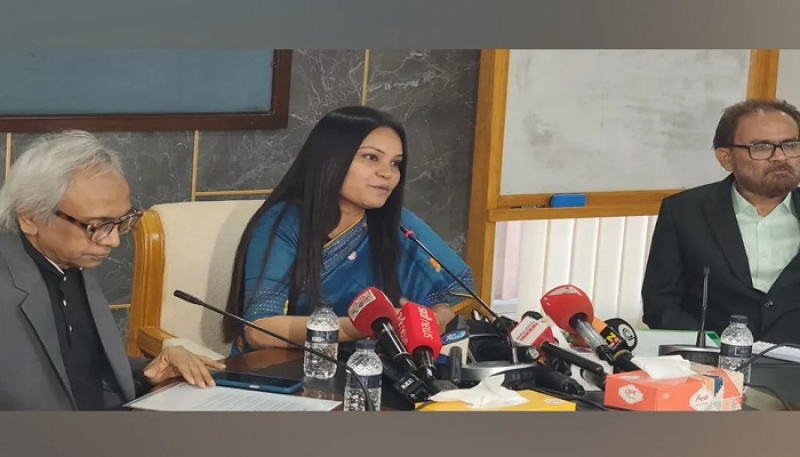
Photo: collected
Chief Information Commissioner Prof. Dr. Nahreen Islam Khan announced on Thursday that the Information Commission has launched a 100-day action plan, emphasizing its dedication to maintaining complete neutrality and independence under the democratic administration.
Speaking at a press briefing held at the capital's Information Commission building, she stated that the initiative was undertaken with the clear vision of keeping the commission impartial.
Addressing inquiries regarding the organization's stance, Nahreen noted that she has frequently faced questions over whether the commission aligns itself with the public or the government.
“My answer is unequivocal: the Information Commission will not stand with the people, nor will it stand with the government; it will remain impartial,” she said.
She expressed her firm belief that a strong Information Commission would help the government move forward on the path of democracy.
The briefing was organised to outline the newly formed commission's future plans and priorities, focusing on the effective implementation of the Right to Information (RTI) Act, 2009, ensuring people's access to information and making the practice of the right to information more dynamic.
Explaining the importance of the RTI Act, she said most laws are enacted by governments to be applied to citizens, but the RTI Act is the only law that an ordinary citizen can use against the government to ensure accountability.
She said one of the initial challenges after joining the commission was that many people did not know what the Information Commission was or what it did.
The commission, therefore, wants to make people aware that there is a strong institution in Bangladesh dedicated to protecting their right to information and that its doors are open to every citizen.
Outlining the 100-day plan, Nahreen said the commission would organise Bangladesh's first RTI fair at the end of November initially at three public and four private universities in Dhaka.
The weeklong initiative will help students understand how they can use the Right to Information Act to pursue their demands and grievances through lawful means.
The commission will also begin hearings on November 16 to address a backlog of 917 complaints accumulated over the past two years, she said.
She said the commission wanted to make its activities more active and effective by addressing both the accumulated and newly filed complaints.
Reiterating the commission's commitment to neutrality, she urged citizens to see themselves as equal members of society and the state and expressed hope that the commission's impartial approach would help strengthen democratic practices.
She acknowledged that the commission is facing significant operational constraints. Although its organisational structure provides for 76 officials, only 22 are currently working in the 15-storey building.
Despite the limited workforce and various obstacles, she said the commission has started working instead of waiting for all its resources to be in place.
Information Commissioner S A M Mahfuzur Rahman said the commission could play a significant role in addressing the problem of information sharing.
He said the commission expected to work jointly with the media to establish transparency in society by ensuring ordinary citizens' access to information.
Mahfuzur said information had become the principal source of power in contemporary society, particularly as artificial intelligence was transforming the world and opening up new possibilities for good governance.
He called on journalists to play a leading role in combating disinformation by distinguishing between misinformation and disinformation and ensuring the flow of objective, authentic and substantiated information.
Information Commissioner Khan Mohammad Abul Hossain, said ensuring freedom of expression was a fundamental prerequisite for the development of democracy, and the right to information was an inseparable part of that freedom.
“Freedom of expression can never flourish without the right to know,” he said.
He said journalists were among those who worked most extensively with information, while the media remained one of the principal sources through which people could exercise their right to know.
Abul Hossain said the Information Commission could not function effectively without the cooperation of the media.
Source: UNB