

- Oil Shock Sends Asian Markets Lower as Middle East Conflict Threatens Global Shipping |
- Trump Links Iran War to US Midterms, Backs United Ireland |
- PM Tarique Rahman Seeks Public Cooperation to Tackle Nationwide Dengue Outbreak |
- Jatiyatabadi Mahila Dal Vows to Lead Fight Against Rape, Violence Against Women and Children |
- 'Honorable' Dropped: PM Starts Implementing Decision from His Own Office |
'Honorable' Dropped: PM Starts Implementing Decision from His Own Office
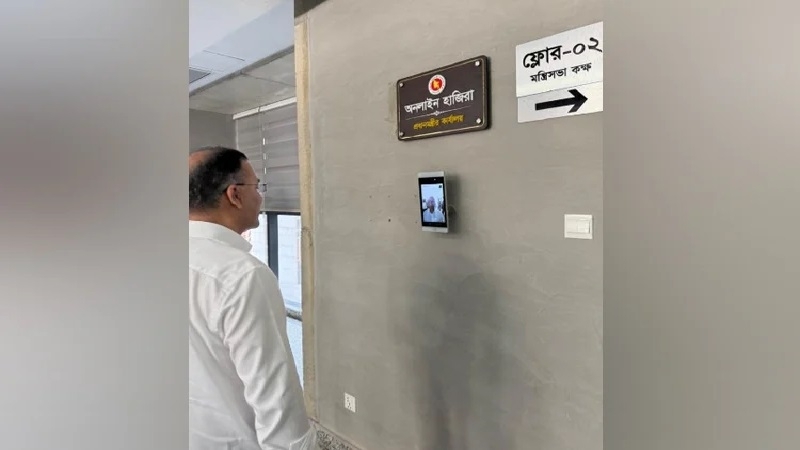
Image: Prime Minister Tareque Rahman
Official documents to use only 'Prime Minister'; PM registers digital attendance, sending a message of administrative discipline and accountability
Prime Minister Tarique Rahman has begun implementing the decision to phase out unnecessary honorific titles for the highest state positions, starting directly with his own office. By dropping the word "Honorable" (Manoniyo) before the Prime Minister's title in official documents and communications, alongside registering digital attendance himself, he has signaled a new era of administrative discipline.
The Cabinet Division stated that starting Thursday (September 10) morning, official documents and activities at the Prime Minister's Office (PMO) transitioned to using solely "Prime Minister" instead of "Honorable Prime Minister." Additionally, the Prime Minister is adhering to the standard protocol of clocking in and out via a digital attendance system.
A senior official at the PMO noted that the Prime Minister registered his digital attendance upon entering his secretariat office on Thursday morning, with the same procedure followed when leaving. Officials view this personal adherence to administrative rules as a direct message to establish punctuality, discipline, and accountability across the civil service.
Honorific Titles Removed Before Official Designations
On Wednesday, the Cabinet Division issued a circular directing that honorific terms such as "His Excellency" (Mohamanyo), "Honorable" (Manoniyo), or similar titles should not be used before the titles of the President, Prime Minister, Ministers, State Ministers, and Deputy Ministers in official government communications, documents, and summary submissions.
Under the new directive, government correspondence and records must refrain from using "His Excellency" before the President's name and "Honorable" before the Prime Minister's name. Instead, offices must directly use official constitutional and government designations, eliminating unnecessary adjectives.
Public Administration Ministry officials confirmed that the decision went into effect on Thursday. Speaking to BSS, Public Administration Secretary Md. Kamruzzaman Chowdhury described the circular as a timely and historic move that has already been put into practice, reflecting the Prime Minister's deep commitment to the nation and its people.
Directives Reach Field Administration
The directive extends beyond the Secretariat and the PMO to field-level administration. The Ministry of Public Administration dispatched the circular to all ministry secretaries, divisional commissioners, deputy commissioners (DCs), and upazila nirbahi officers (UNOs).
Md. Sakhawat Hossain, Additional Secretary to the Ministry of Public Administration, confirmed that the circular regarding the omission of honorifics in official correspondence has been delivered to all relevant departments and enforced immediately. He added that officials have been cautioned against any deviations in future communications, with the notice also distributed digitally across all tiers of administration.
Official Designation Considered Sufficient
Government officials emphasized that constitutional and official titles are sufficient to represent individuals in key state positions. Prioritizing duty and status over superfluous adjectives serves to depersonalize state institutions.
The fact that implementation began at the Prime Minister's Office adds significant weight to the policy. Officials noted that with the head of government following the rule himself, compliance expectations across other levels of administration naturally intensify.
Tanvir Ahmed, Joint Secretary of the Cabinet Division's District Magistracy Branch, told BSS that the directive has reached all levels of field administration, with several official letters already reflecting the change on Thursday. Strict measures will be taken if any department fails to comply.
Leading by Example via Digital Attendance
Alongside dropping honorifics, the Prime Minister's use of digital attendance has drawn widespread attention. While digital attendance systems exist across various government institutions to ensure punctuality, the Prime Minister setting a personal example reinforces the principle that no individual, regardless of their stature, is above institutional rules.
Senior PMO officials reconfirmed that the biometric clocking system is routinely used upon entering and exiting the office.
Reducing Protocol Formalities
Since assuming office as Prime Minister, initiatives have been launched to reduce personalism and unnecessary formalities in state affairs. Measures already implemented include:
* Discontinuing the use of the Prime Minister's photograph in government advertisements and activities.
* Reducing the number of vehicles in the Prime Minister's motorcade.
* Keeping traffic signals open for the public during presidential and prime ministerial movements.
* Restricting the use of flag cars except for official state ceremonies at home and abroad.
These steps underscore a central message: institutional frameworks, responsibilities, and rules take priority over special titles and privileges.
Administrative Impact
While long-term impact depends on consistent field enforcement, the unified rollout from central to local administrative tiers marks a structural shift. The Prime Minister's personal adherence to basic workplace rules provides strong symbolic value, fostering a culture of punctuality, compliance, and accountability throughout the administration.