

- Oil Shock Sends Asian Markets Lower as Middle East Conflict Threatens Global Shipping |
- Trump Links Iran War to US Midterms, Backs United Ireland |
- PM Tarique Rahman Seeks Public Cooperation to Tackle Nationwide Dengue Outbreak |
- Jatiyatabadi Mahila Dal Vows to Lead Fight Against Rape, Violence Against Women and Children |
- 'Honorable' Dropped: PM Starts Implementing Decision from His Own Office |
Clavicular’s Rise to Fame: Looksmaxxing, the Black Pill and the New Internet Masculinity
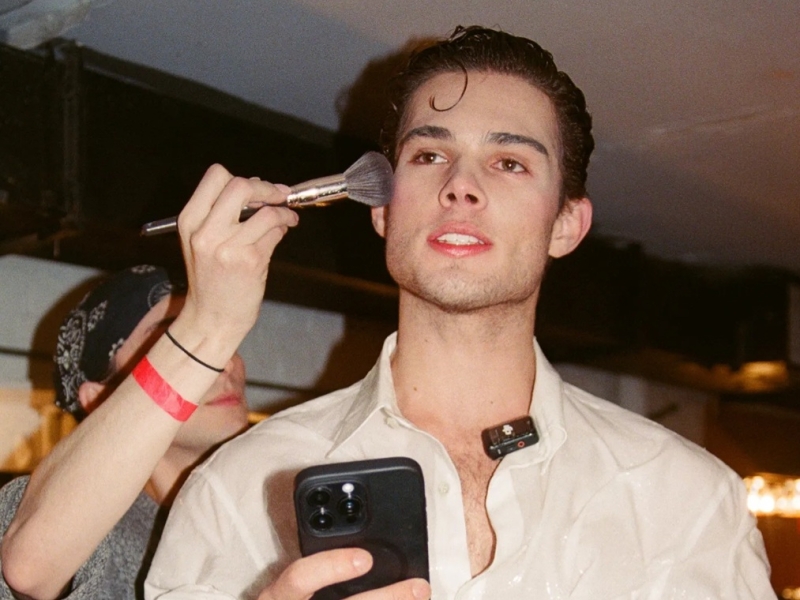
Image: Collected
Few internet personalities have moved from an obscure online subculture into mainstream attention as quickly as Braden Peters, better known online as Clavicular. At just 20, Clavicular has become one of the most recognizable faces of the modern “looksmaxxing” movement—a digital culture built around maximizing physical attractiveness. His rise, however, is about more than facial aesthetics. It also reveals how looksmaxxing overlaps with the darker Black Pill worldview and how fringe internet communities can migrate into mainstream social media.
Clavicular’s popularity exploded through TikTok, Kick and short-form video platforms. His content combined discussions about appearance with bodybuilding, facial aesthetics, dating, provocative livestreams and deliberately shocking behavior. According to Bloomberg, tens of thousands of clips featuring him generated billions of views across TikTok and Instagram Reels in a short period, illustrating the enormous power of the modern clipping economy.
From Looksmaxxing to Internet Celebrity
The term looksmaxxing refers broadly to attempts to maximize one's physical attractiveness. Some practices are relatively ordinary: exercising, improving one's hairstyle, skincare, dressing better, maintaining good posture or improving sleep.
But the online subculture also contains much more extreme practices. Clavicular became famous partly because he publicly documented an unusually aggressive approach to changing his appearance, including discussions surrounding testosterone, facial manipulation and other controversial techniques. His willingness to turn his own body into content helped make him an ideal subject for viral clips.
His online name itself reflects this obsession. “Clavicular” refers to the clavicle, or collarbone, which has become an important feature in the appearance-based measurements used by parts of the looksmaxxing community.
By early 2026, mainstream publications were profiling him as one of the most visible faces of the movement. The New York Times, Guardian, GQ and other outlets helped move his story beyond niche forums and into mainstream cultural discussion.
Where the Black Pill Enters
To understand the overlap between Clavicular's audience and the Black Pill community, it is important to distinguish the two.
Looksmaxxing is primarily a practice or culture centered on improving appearance. Black Pill ideology is a much darker worldview associated with certain corners of the manosphere and incel communities. At its most extreme, it argues that physical attractiveness and perceived genetic advantages largely determine romantic and social outcomes—and that people who are considered unattractive have little ability to change their circumstances.
This creates an obvious connection.
If looksmaxxing asks, “How can I become more attractive?”, the Black Pill often begins with the assumption that “your appearance determines how successful you can be.”
The result is an ecosystem where facial symmetry, jawlines, height, body proportions and other physical characteristics can become obsessive measurements of personal worth.
Academic research published in 2026 examining Clavicular's case describes him as an example of the “diffusion” of looksmaxxing from fringe online spaces into wider internet culture.
The Language of the Subculture
Part of Clavicular's influence comes from the strange vocabulary surrounding these communities.
Words such as “mogging,” “Stacy,” “foid,” “LARPMAXXED” and other expressions can appear almost incomprehensible to outsiders. Yet language is one of the mechanisms through which online communities create identity.
“Mogging,” for example, generally describes being perceived as superior to another person in appearance or status. A person who is considered significantly more attractive may be said to have “mogged” someone else.
The terminology did not originate with Clavicular. Much of it emerged from earlier manosphere, incel and imageboard communities. What changed was the audience. Social media transformed obscure vocabulary into memes that could be consumed by millions of people who may have little understanding of its ideological origins.
This is one reason Clavicular matters culturally: he did not invent the ecosystem, but he helped make its language visible.
The Algorithm Loves Extremes
Clavicular's rise also demonstrates something fundamental about modern internet fame: controversy can function as an extremely effective distribution mechanism.
A conventional fitness creator might post a workout. A conventional fashion creator might post an outfit. Clavicular's content often combines appearance, masculinity, controversy, nightlife and shock value.
That combination is particularly suited to short-form platforms.
A livestream can produce dozens of clips. Each clip can be stripped of context and distributed independently. Viewers who have never watched the original stream encounter a few seconds of an unusual statement, confrontation or reaction.
The more surprising the clip, the more likely people are to share it.
The Verge has examined this wider “clipping” economy, in which short excerpts from livestreams and other long-form content can become an enormous source of exposure. Clavicular became one of the prominent examples of how this model can propel an internet personality into mainstream visibility.
In this environment, outrage and fascination can become equally valuable forms of engagement.
When Self-Improvement Becomes Fatalism
There is a fundamental contradiction at the heart of the looksmaxxing–Black Pill overlap.
Self-improvement traditionally suggests that people can change their lives through effort. Exercise, education, grooming, confidence and social skills are examples.
The Black Pill introduces a much more deterministic idea: that biology and appearance establish a hierarchy from which people cannot easily escape.
Looksmaxxing can therefore occupy the space between optimism and fatalism.
One version says:
«Improve what you can control.»
The darker version says:
«Your appearance determines your value, and there may be very little you can control.»
That distinction matters.
When appearance becomes a hobby, it can simply mean taking greater care of oneself. When appearance becomes the central measure of human worth, however, the pursuit can become psychologically destructive.
The modern “maxxing” trend has already expanded beyond looks into numerous forms of extreme self-optimization, while critics have raised concerns about dangerous practices and unrealistic beauty standards.
Why Young Men Are Drawn to It
The popularity of this culture cannot simply be explained by misogyny or internet extremism. There is also a genuine demand for answers among young men dealing with insecurity, loneliness, dating anxiety and pressure surrounding masculinity.
Looksmaxxing offers an apparently simple formula:
Identify your weaknesses → change your appearance → become more attractive → gain confidence and social status.
That simplicity is powerful.
It gives people numbers, rankings, routines and supposedly objective measurements in an area of life that is otherwise complicated and uncertain.
The danger appears when those measurements become a substitute for a broader understanding of relationships and self-worth.
A person's attractiveness is not a mathematical equation, and romantic relationships cannot be reduced to facial ratios, height or bone structure.
Clavicular’s Most Important Contribution May Be Cultural
Whether one views Clavicular as an influencer, provocateur, entertainer or symptom of a larger cultural phenomenon, his rise represents something bigger than one personality.
He has helped demonstrate how a niche internet subculture can move through several stages:
forum culture → memes → TikTok clips → livestreaming → mainstream media → mainstream vocabulary.
Terms that once belonged to obscure online communities are now recognizable to millions of people.
That does not mean everyone using the word “mog” has adopted Black Pill ideology. Nor does participation in looksmaxxing automatically make someone an incel or an extremist. These communities contain people with very different beliefs.
But the overlap is real enough to deserve attention.
Clavicular sits at precisely that intersection: beauty culture, fitness culture, influencer culture, the manosphere and algorithm-driven shock entertainment.
The Bigger Question
Clavicular's story ultimately raises a broader question about the internet: What happens when a fringe worldview becomes entertainment before people understand where it came from?
The answer may be visible in the rapid spread of looksmaxxing.
Millions of young people can encounter its vocabulary without ever visiting the forums where much of that terminology originated. Some may treat it as harmless memes. Others may use it as motivation to exercise and improve their appearance. A smaller group may move deeper into communities built around pessimistic or misogynistic beliefs.
That spectrum is important.
The story of Clavicular is therefore not simply the story of a young man becoming famous because he wanted to look better. It is the story of how appearance, insecurity, masculinity, algorithms and fringe internet ideology can collide—and how quickly that collision can become mainstream culture.
His fame shows that the internet no longer keeps its subcultures neatly separated. A meme can become a lifestyle. A lifestyle can become an ideology. And an ideology can become entertainment.
That may be the real legacy of the Clavicular phenomenon: not that he invented looksmaxxing or the Black Pill, but that he became one of the clearest examples of how the internet can take ideas from its darkest corners and turn them into mass-market culture.