

- Oil Shock Sends Asian Markets Lower as Middle East Conflict Threatens Global Shipping |
- Trump Links Iran War to US Midterms, Backs United Ireland |
- PM Tarique Rahman Seeks Public Cooperation to Tackle Nationwide Dengue Outbreak |
- Jatiyatabadi Mahila Dal Vows to Lead Fight Against Rape, Violence Against Women and Children |
- 'Honorable' Dropped: PM Starts Implementing Decision from His Own Office |
Afghanistan War Victims Still Await Justice, UN Says
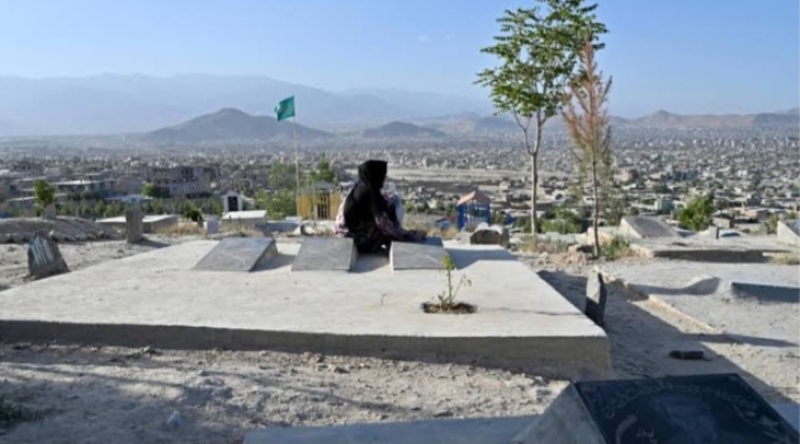
Image: Collected
Most civilian victims of Afghanistan’s two-decade war between 2001 and 2021 have yet to receive justice, compensation or even formal recognition for their suffering, according to the United Nations.
The conflict began after the United States launched a military intervention in Afghanistan following the September 11, 2001 attacks. Over the next 20 years, civilians were caught in violence involving the Taliban, Islamic State militants, Afghan security forces and the US-led international coalition.
According to the UN Assistance Mission in Afghanistan (UNAMA), more than 40,000 civilians were killed and over 77,000 injured during the period documented by the mission. UNAMA has recorded civilian casualties since 2009 in one of the most extensive assessments of the war’s human cost.
Families still carrying the scars
The human cost of the conflict remains visible at Kabul’s Tapa-e-Shuhada, or Martyrs’ Hill, where numerous graves commemorate victims of the violence. Many of those buried there belonged to Afghanistan’s Hazara community, which was repeatedly targeted by Taliban and Islamic State attacks.
Among the victims was 21-year-old Suhaila, who died in an attack at Kabul University. Another grave belongs to 17-year-old Muhammad Hadi, who was killed in a 2020 Islamic State-claimed attack on a school where students were preparing for university entrance examinations.
Mohammad, 25, survived the same attack but suffered lasting psychological trauma. He had hoped to become a computer engineer but was forced to abandon his studies and now works intermittently as a tailor.
“The world has forgotten us,” he told AFP.
‘No one listened’
For many families, seeking justice has proved equally painful.
Khan Yousuf, a farmer from Logar province, recalled how his eight-year-old son was killed when an Afghan police tank opened fire outside their home. His wife was also wounded while rushing toward the child.
Yousuf said he filed complaints with authorities under Afghanistan’s former republic and made repeated attempts to obtain justice, but without success. Since the Taliban returned to power, he said, pursuing his case has become even more difficult.
The UN said most victims interviewed by UNAMA described a profound sense of injustice and abandonment. A 2006 government initiative called the Peace, Reconciliation and Justice Action Plan was never fully implemented.
The 2020 US-Taliban peace agreement also contained no specific provisions addressing victims’ rights, justice or accountability.
Accountability efforts remain limited
Since returning to power, the Taliban authorities have introduced an amnesty law and have shown little public willingness to prosecute perpetrators of past human-rights violations, UNAMA said.
International efforts to hold those responsible accountable have also faced significant obstacles.
The International Criminal Court opened an investigation into the Afghanistan conflict, although its prosecutor later narrowed the focus toward alleged crimes by the Taliban and Islamic State, citing limited resources and the seriousness of the crimes.
There have been some developments. In 2022, a Dutch court ordered the Netherlands to compensate relatives of victims killed in a 2007 airstrike in Afghanistan that was ruled unlawful. A former Australian special forces officer has also faced war-crimes charges, although the case remains unresolved.
Experts have suggested that Afghanistan could draw lessons from truth and reconciliation processes used in countries such as South Africa, while reparations could provide another avenue for victims and their families.
The Taliban government has told UNAMA that it has distributed around $695 million since 2021 to families of martyrs, widows and orphans.
But for survivors such as Yousuf, financial support alone cannot erase the pain of losing loved ones.
He said he would like his wife to receive better medical treatment, while another survivor expressed hope that the younger generation could eventually rebuild the lives that war disrupted.
The UN's assessment underscores the enduring consequences of Afghanistan's 2001-2021 conflict, with thousands of victims and families still waiting for recognition, accountability and meaningful justice.