

- Shama urges accessible, cost-free climate funding that works for women |
- Rizvi says Hasina must return through extradition, not a ceremonial welcome |
- Civic memorial to mark the first death anniversary of Khaleda Zia |
- Low-pressure area forms in Bay of Bengal, may create cyclone |
- Over 150 garment factories shut in Ashulia amid labour unrest, 50 injured |
Rizvi says Hasina must return through extradition, not a ceremonial welcome
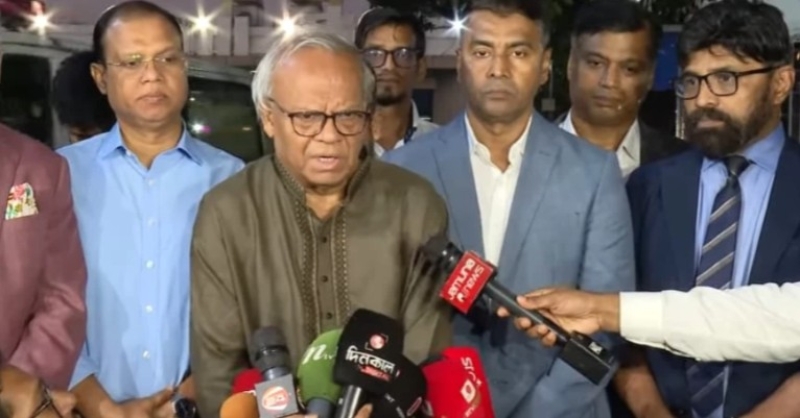
BNP Acting Secretary General Ruhul Kabir Rizvi has said ousted prime minister Sheikh Hasina must be brought back to Bangladesh under the existing extradition treaty with India, arguing that her return should not be treated like an ordinary homecoming.
“Many people have been killed, and numerous cases have been filed against Sheikh Hasina. She has also been convicted and sentenced to death for crimes against humanity. Yet, discussions about bringing her back make it sound as if she had gone to her parents’ or in-laws’ home and should be welcomed with flowers,” he said.
Rizvi made the remarks on Friday while speaking at a discussion organised by the Jatiyatabadi Mohila Dal at the Jatiya Press Club to mark National Revolution and Solidarity Day.
Referring to reports that Hasina intends to return to Bangladesh and has applied for a passport, visa and national identity card, Rizvi ruled out repatriation, saying extradition was the only available route.
He explained that extradition is a legal process between two countries, whereas repatriation generally involves someone returning to their country without facing criminal allegations there.
Rizvi questioned whether someone facing criminal cases, state prosecution and court sentences could use the ordinary process of applying for travel documents to return home. He said Hasina's case must instead be handled through the extradition arrangement between Bangladesh and India.
The BNP leader alleged that Hasina was responsible for the deaths of around 1,400 people, including students and rickshaw-pullers, during the July 2024 mass uprising. He added that several cases against her remain pending and that she has already received sentences, including the death penalty.
He said Hasina should face the ongoing proceedings in Bangladesh and serve the sentences imposed by the courts rather than receive a celebratory welcome.
Speaking about women's participation in politics, Rizvi praised BNP women leaders and activists for their role in the movement for democracy over the past 17 years.
He recalled that police had repeatedly placed barricades to stop their political programmes, while women activists attempted to overcome them despite the risks of arrest, enforced disappearance and harassment.
Bangladesh is seeking Hasina's extradition from India under the bilateral treaty. India, meanwhile, has said travel documents are necessary for people to travel.
Hasina fled to India on August 5, 2024, after student-led protests forced her from power and has remained there since. In 2025, a special tribunal in Bangladesh sentenced her to death for crimes against humanity committed during the mass uprising.