

- Oil Shock Sends Asian Markets Lower as Middle East Conflict Threatens Global Shipping |
- Trump Links Iran War to US Midterms, Backs United Ireland |
- PM Tarique Rahman Seeks Public Cooperation to Tackle Nationwide Dengue Outbreak |
- Jatiyatabadi Mahila Dal Vows to Lead Fight Against Rape, Violence Against Women and Children |
- 'Honorable' Dropped: PM Starts Implementing Decision from His Own Office |
Rohingya Refugees Rally in Cox’s Bazar, Demand Justice and Safe Return
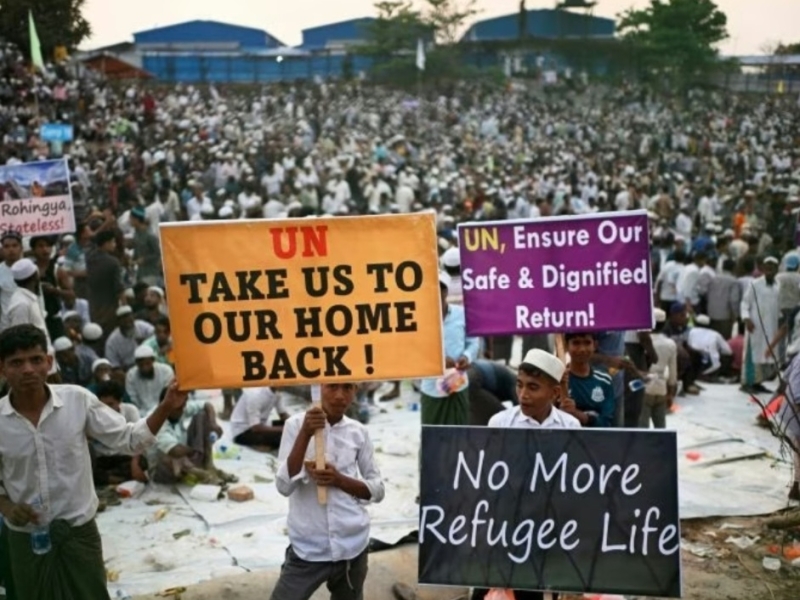
Image: Collected
Tens of thousands of Rohingya refugees gathered in Bangladesh’s Cox’s Bazar on Tuesday to protest deteriorating conditions in the overcrowded camps and call for greater international assistance.
The United Council of Rohingya refugee group said it organised the rally to remember the atrocities committed against the Rohingya and draw attention to the ongoing humanitarian crisis, marking the ninth anniversary of the mass exodus from Myanmar.
Conditions in the camps have worsened amid reductions in funding, limited food rations and cuts to essential services, according to aid organisations.
Oxfam warned that declining humanitarian resources could reverse progress made in Cox’s Bazar, with essential services already under severe pressure.
Reporting from Cox’s Bazar, Al Jazeera correspondent Tanvir Chowdhury said the protesters wanted the international community to focus on their demands.
“They want justice, they want dignity, and a safe return home,” he said.
Bangladeshi authorities have said they are already overstretched and have called for the Rohingya to return to their homeland in a dignified manner.
The 2017 Myanmar military crackdown, during which Rohingya villages were burned and civilians were killed, is the subject of a genocide case at the International Court of Justice in The Hague.
In a joint statement, 16 diplomatic missions in Bangladesh, including those of the European Union, the United Kingdom and Canada, said conditions in Myanmar were not suitable for the safe repatriation of Rohingya refugees.
“Rohingya refugees have a right to return to their homes in Myanmar,” the statement said.
It added that conflict was escalating across Rakhine State while humanitarian needs were increasing, with insecurity, airstrikes on civilian infrastructure and restrictions on aid and trade worsening the crisis.
UN Secretary-General Antonio Guterres also called for “renewed global attention and action” for the Rohingya.
UN spokesman Stephane Dujarric said Rohingya people in Myanmar, Bangladesh and elsewhere in the region were facing growing insecurity, reduced protection and diminishing prospects for a lasting solution, while funding cuts were affecting life-saving humanitarian assistance.