

- Oil Shock Sends Asian Markets Lower as Middle East Conflict Threatens Global Shipping |
- Trump Links Iran War to US Midterms, Backs United Ireland |
- PM Tarique Rahman Seeks Public Cooperation to Tackle Nationwide Dengue Outbreak |
- Jatiyatabadi Mahila Dal Vows to Lead Fight Against Rape, Violence Against Women and Children |
- 'Honorable' Dropped: PM Starts Implementing Decision from His Own Office |
The Invite: A Dinner Party That Turns Into a Sharp Examination of Modern Relationships
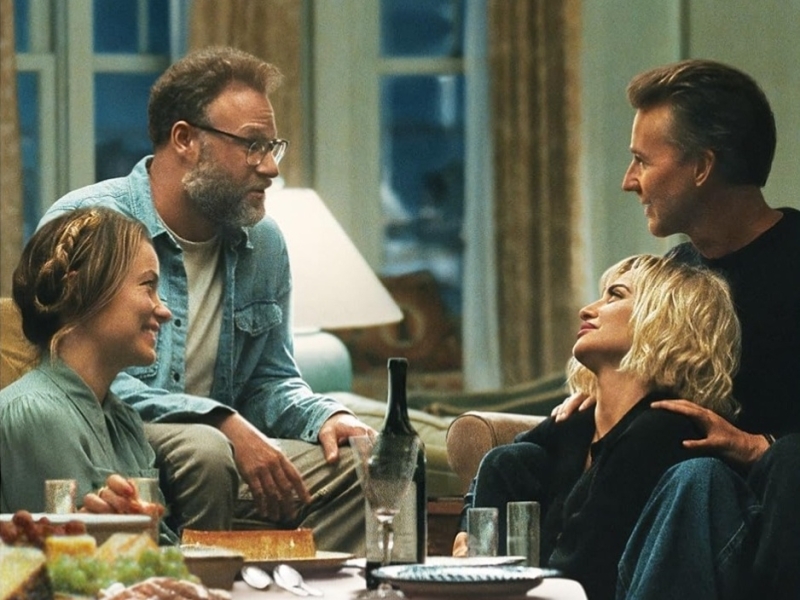
Image: Collected
Olivia Wilde’s The Invite is the kind of movie that looks deceptively simple. Four people sit around a dinner table, drink, talk, flirt, argue and gradually reveal uncomfortable truths about themselves. But beneath its darkly comic surface, the film is really interested in something far more complicated: what happens when people who have become strangers to each other are suddenly forced to confront the lives they have been avoiding.
Now available digitally since August 11, The Invite stars Wilde alongside Seth Rogen, Penélope Cruz and Edward Norton. The film is an English-language remake of Cesc Gay’s 2020 Spanish comedy-drama The People Upstairs.
At the centre are Joe and Angela, a married couple whose relationship has clearly lost much of its warmth. Angela invites their mysterious upstairs neighbours, Piña and Hawk, to dinner. What begins as an attempt at an ordinary social evening gradually becomes a psychological and emotional minefield.
The movie understands that awkwardness can be funnier—and sometimes more revealing—than conventional jokes. Instead of constantly trying to manufacture big comedic moments, Wilde allows conversations to become increasingly uncomfortable. A seemingly innocent comment can expose resentment. A joke can reveal insecurity. A flirtatious exchange can suddenly make a marriage look completely different.
Seth Rogen is particularly effective because the role demands more than his familiar comedic persona. Joe is funny, but he is also defensive, insecure and increasingly uncomfortable with the people around him. Rogen's ability to let the humour slowly give way to vulnerability gives the character surprising depth.
Wilde is equally interesting as Angela. Her character isn't simply an unhappy wife looking for excitement. She represents someone who has become emotionally isolated while still living inside a conventional relationship. Her invitation to the neighbours feels less like a casual dinner plan and more like an attempt to break through years of emotional stagnation.
Then there are Penélope Cruz and Edward Norton, who bring an almost alien energy into the apartment. Their characters appear liberated in ways Joe and Angela aren't. But the movie wisely avoids portraying them as simply the "cool" couple who have figured life out. They have their own contradictions, desires and problems.
That is perhaps the film's biggest strength: nobody is completely innocent.
The Invite isn't really asking whether monogamy is good or bad, whether unconventional relationships are better than traditional ones, or whether couples should behave more like their supposedly liberated neighbours. Instead, it asks a more uncomfortable question: Are we actually honest with the people we claim to know best?
The dinner table becomes almost like a stage. Every character performs a version of themselves, and the longer the evening continues, the harder it becomes to maintain that performance.
Wilde's direction is also surprisingly controlled. The relatively confined setting could easily have made the film feel like a filmed stage play, but the movie uses the apartment as a pressure cooker. The lack of constant location changes actually makes the characters' emotional movements more important.
Even the costumes contribute to that feeling. Costume designer Arianne Phillips has described The Invite as deliberately restrained compared with her more visually extravagant work, using small details such as watches and jewellery to communicate personality.
There are, however, moments when the film's cleverness becomes slightly too obvious. Some of the conversations feel engineered to expose character flaws, and viewers looking for a straightforward comedy may find the movie increasingly uncomfortable as it moves deeper into relationship drama.
But I think that discomfort is ultimately part of the point.
The Invite is not a movie about a dinner that goes wrong. It is a movie about four people discovering that the lives they have carefully constructed may not be making them happy.
Its critical reception reflects that ambition. Rotten Tomatoes currently lists the film at 97% from critics and 89% from verified audience ratings, with critics particularly praising the ensemble performances and Wilde's direction.
What makes the film worth watching digitally is that it doesn't treat relationships as neat romantic stories. People change. Desire changes. Marriage changes. And sometimes the most dangerous person in a relationship isn't an outsider—it is the version of yourself you have been pretending to be.
The Invite is therefore best approached not as a conventional romantic comedy, but as a sophisticated, uncomfortable dinner-party satire. It makes you laugh, but then makes you question why you're laughing.
If you enjoy movies built around sharp dialogue, uncomfortable social situations and characters slowly destroying the masks they wear, The Invite is one of the more interesting films to catch on digital this month. It is currently available to rent or buy through major digital platforms, although subscription streaming availability is separate from its current digital release.