

- Zelenskyy warns Starshield limits are hindering drone interceptions |
- Govt considers revamping school food distribution system |
- Service tenure expiry leads to retirement of five BAF officers |
- HSC supplementary exams scheduled to begin on December 1 |
- US ambassador meets Indian High Commissioner amid political uncertainty |
Inside Sacred House: The Blood Red Underground Pool Inspired by Dante’s Circles of Hell
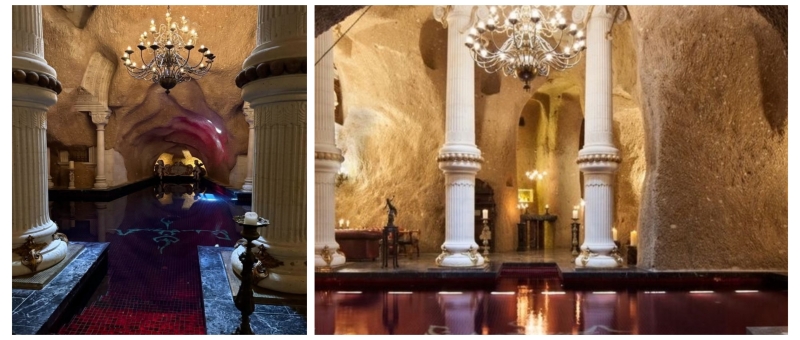
Image: Collected
Sacred House in Ürgüp, Cappadocia, drew its architectural identity from a rare meeting of history, landscape and literature. Housed in a restored 250 year old Greek mansion, the hotel combined original Anatolian stonework with gothic, baroque and neoclassical influences to create an atmosphere inspired by Dante’s Divine Comedy.
A Mansion With Layers of History
The building at the heart of Sacred House was believed to date back approximately 250 years and originated as a Greek noble residence. Over its long life, it served as a private home, a place of worship and a community landmark before its transformation into a boutique hotel.
The property was restored from a state of near ruin by its present owners. Rather than erasing its past, the restoration preserved original stone walls, vaulted ceilings and structural features, allowing the mansion’s historic character to remain central to the hotel’s identity.
Architecture Inspired by Literature
Architect and owner Turan Gülcüoğlu shaped Sacred House as more than a hotel. His stated aim was to create a sophisticated, intellectual and aristocratic space for high culture, a refuge with a distinctive energy, aura and virtue.
The interiors blended gothic drama, romanticism, medieval references and neoclassical detail. Winged angel figures, pointed arches, carved reliefs, moulded stonework, candlelit corridors and antique furnishings gave the property the feel of a living historical set rather than a conventional hotel.
Each of the hotel’s 23 rooms and suites carried its own name and narrative, including the Archangel, Harem, Byzantium Treasury, Lilith, Oracle and Sanctuary. The individually designed spaces used antiques, exposed stone, fireplaces and carefully chosen period details to reinforce the hotel’s theatrical atmosphere.
Dante’s Influence Underground
The most famous expression of the hotel’s literary inspiration was Inferno Spa, located beneath the streets of Ürgüp. Guests reached it through a portico in the atrium and descended a circular staircase into a rock carved basement, an approach designed to evoke an underworld.
At the centre of the spa was the celebrated Bloody Pool, a heated indoor swimming pool lined with deep red mosaic and lit to resemble hellfire. The space also included arches, columns, candelabras, a fireplace and a chandelier suspended above the water, creating the impression of an ancient structure partially revealed by excavation.
The spa drew on Dante’s Divine Comedy, particularly Inferno, and connected the hotel’s broader themes of heaven, purgatory and the underworld. Alongside the pool, guests found a traditional Turkish hammam, sauna and treatment rooms.
Located in Historic Ürgüp
Sacred House stood in the historic centre of Ürgüp, one of Cappadocia’s most culturally significant towns. The hotel was about 800 metres from the town centre, placing guests within walking distance of local restaurants, shops and historic stone streets.
Ürgüp had long been regarded as a commercial and wine producing heart of Cappadocia. Its surrounding volcanic landscape, fairy chimneys, rock cut churches and underground cities made it a natural base for exploring the wider region.
The hotel was also well connected for travellers. Nevşehir Kapadokya Airport was approximately 50 minutes away by road, while Kayseri Erkilet Airport was about 75 minutes away.
A Hotel Built Around Atmosphere
Sacred House positioned itself as a sensory and philosophical experience rather than simply a place to sleep. Its design balanced light and shadow, historic architecture, art, literature and Cappadocia’s ancient stone landscape.
The result was a property where a 250 year old mansion, Dante inspired symbolism and the dramatic geography of Cappadocia came together beneath one roof, and, in the case of Inferno Spa, beneath the ground itself.