

- Oil Shock Sends Asian Markets Lower as Middle East Conflict Threatens Global Shipping |
- Trump Links Iran War to US Midterms, Backs United Ireland |
- PM Tarique Rahman Seeks Public Cooperation to Tackle Nationwide Dengue Outbreak |
- Jatiyatabadi Mahila Dal Vows to Lead Fight Against Rape, Violence Against Women and Children |
- 'Honorable' Dropped: PM Starts Implementing Decision from His Own Office |
China Reaffirms Party Control Over Military as PLA Nears Centenary
Beijing says anti-corruption drive and Mao-era principles remain central to ensuring the armed forces serve Communist Party leadership
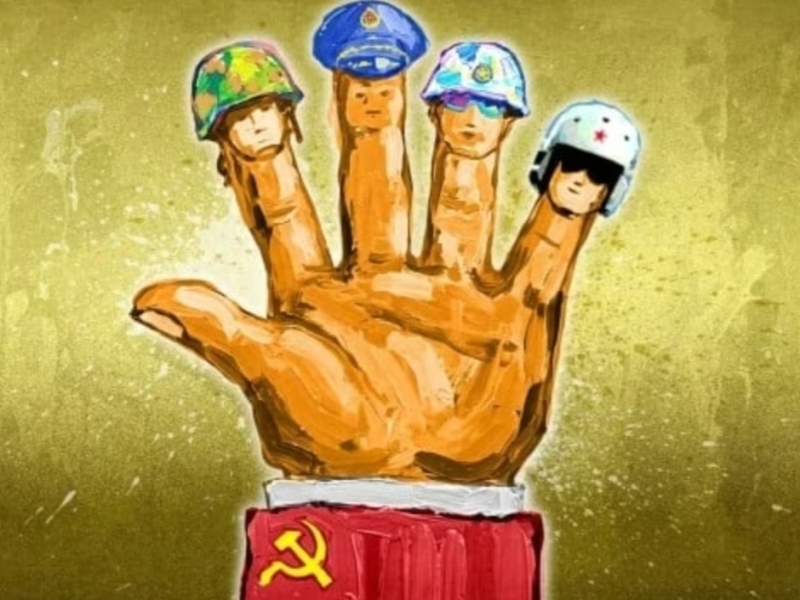
Image: Collected
As the People’s Liberation Army (PLA) approaches its 100th anniversary next year, China continues to reinforce the Communist Party’s absolute control over the military through ideological guidance and an extensive anti-corruption campaign.
The approach traces its roots to Mao Zedong’s long-standing doctrine that the Communist Party must always command the military. In 1938, Mao wrote that while the party commands the gun, the gun must never command the party, a principle that remains at the core of China’s military and political system.
The foundations of that policy were laid during the 1929 Gutian Conference in Fujian Province, where the Communist Party established political organisations throughout its armed forces and defined the military as an instrument for carrying out the revolution’s political objectives. Those principles continued to shape the party’s military structure through the Communist victory in 1949 and the creation of the PLA.
President Xi Jinping renewed those doctrines in 2014 by convening a military political work conference in Gutian, stressing that the party’s absolute leadership over the military is the cornerstone of building a strong armed force.
The following year, Beijing launched sweeping military reforms alongside one of the most extensive anti-corruption campaigns in decades. The reforms affected every level of the PLA, including service branches, theatre commands, procurement systems and senior military appointments.
The anti-corruption drive also reached the Central Military Commission (CMC), China's highest military command body headed by Xi. Five of its seven members, including former vice-chairmen Zhang Youxia and He Weidong, have been removed from office during the current term that began in 2022.
At present, only Xi Jinping and Vice-Chairman Zhang Shengmin remain on the commission. Official media accused dismissed leaders of undermining the CMC chairman responsibility system and contributing to political and corruption-related problems that threatened the Communist Party’s control over the military.
Several senior military figures have also faced corruption charges in recent years. Former defence ministers Li Shangfu and Wei Fenghe were removed from office, expelled from the Communist Party and later received suspended death sentences. Former political work chief Miao Hua and former CMC vice-chairman He Weidong were also expelled over corruption and serious disciplinary violations.
Analysts say Beijing's emphasis on party leadership extends far beyond fighting corruption. They argue that the Communist Party considers direct control of the military essential to maintaining political stability and preventing challenges to its authority.
Scholars note that the party draws lessons from the collapse of the Kuomintang government during China's civil war and from the dissolution of the Soviet Union, believing that weakening political control over the armed forces could threaten the ruling party's survival.
Unlike many national militaries, the PLA operates under direct Communist Party leadership. Party organisations exist throughout the military, while political commissars share authority with commanders. Military appointments, education and discipline are also supervised by party institutions.
Following the 2014 Gutian meeting, China strengthened the CMC chairman responsibility system through new reporting, inspection and information mechanisms, ensuring major military decisions are directed by the commission's chairman. The reforms were later incorporated into the Communist Party's constitution in 2017.
Experts say the Chinese leadership believes the PLA has historically played a decisive role during major political crises and continues to regard absolute party leadership over the military as fundamental to preserving Communist Party rule.
Source: South China Morning Post