

- Zelenskyy warns Starshield limits are hindering drone interceptions |
- Govt considers revamping school food distribution system |
- Service tenure expiry leads to retirement of five BAF officers |
- HSC supplementary exams scheduled to begin on December 1 |
- US ambassador meets Indian High Commissioner amid political uncertainty |
Dhaka and Ankara Move Toward a Strategic Partnership: Trade, Defence and Rohingya Cooperation Take Centre Stage
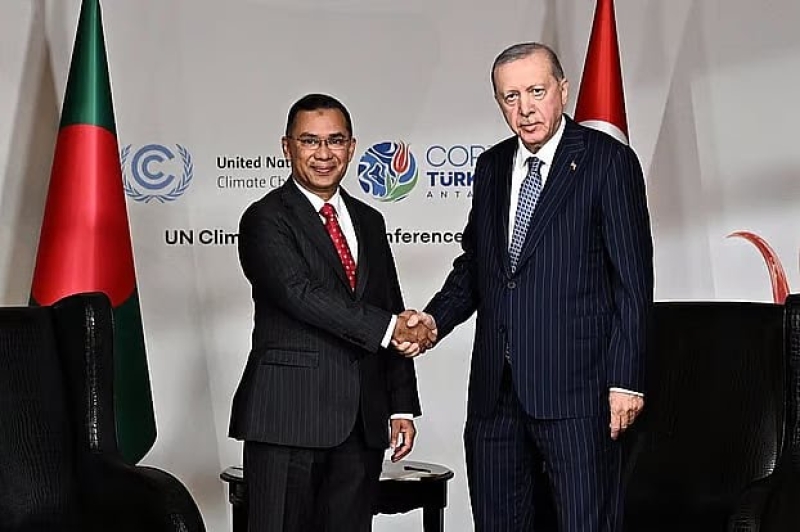
Image: Collected
Bangladesh and Türkiye are entering a new phase in their relationship, with growing cooperation in trade, investment, energy, aviation and defence. Recent meetings between Prime Minister Tarique Rahman and President Recep Tayyip Erdoğan signal an effort to move ties beyond routine diplomacy toward a more institutionalised strategic partnership.
What was discussed
At their 10 November meeting in Antalya, the two leaders focused on expanding cooperation in trade, investment, energy, mineral resources, aviation and the defence industry. They also discussed climate-change risks and a lasting solution to the Rohingya crisis.
Prime Minister Rahman emphasised deeper and more diversified defence cooperation, including joint investment and the possible development of Bangladesh’s domestic defence industry with Turkish investment.
From strained ties to renewed engagement
Relations had soured after Türkiye objected to death sentences handed to Jamaat-e-Islami leaders over 1971 war-crimes trials, leading Ankara to withdraw its ambassador in 2016. The relationship later improved after Bangladesh expressed support for Erdoğan following the failed 2016 coup and after Türkiye became involved in Rohingya humanitarian assistance.
Türkiye’s support for Bangladesh on the Rohingya issue—including humanitarian aid, a field hospital in Cox’s Bazar and backing for Bangladesh’s case against Myanmar at the International Court of Justice—has remained an important element of bilateral ties.
Trade and investment
Bilateral trade reached about $1.35 billion in 2025, and both countries aim to raise it to $2 billion. Turkish firms have already invested in Bangladesh, including Arçelik’s roughly $75 million acquisition of a majority stake in Singer Bangladesh in 2020 and Aygaz’s $100 million energy project with United Group.
Business leaders see room for growth in ready-made garments, textiles, pharmaceuticals, leather goods, machinery, electronics and energy. Still, both sides face the challenge of increasing investment, diversifying exports and strengthening business-to-business links.
Defence cooperation
Defence has become one of the most visible areas of cooperation. Bangladesh reportedly bought about $60 million in Turkish military equipment in 2021, while the two countries have expanded military dialogue, training, joint exercises and cooperation in UN peacekeeping.
Bangladesh is seeking not only equipment purchases but also technology transfer, maintenance capacity and joint production. The proposed Two-Plus-Two dialogue—bringing together the countries’ foreign and defence ministers—could give defence cooperation a broader strategic framework.
The road ahead
Despite political changes in Dhaka, engagement with Ankara has continued across successive governments, suggesting that shared interests in trade, investment and security have created a durable foundation. The key test now is whether high-level goodwill can be converted into concrete gains in investment, technology transfer, defence manufacturing and bilateral trade.