

- Zelenskyy warns Starshield limits are hindering drone interceptions |
- Govt considers revamping school food distribution system |
- Service tenure expiry leads to retirement of five BAF officers |
- HSC supplementary exams scheduled to begin on December 1 |
- US ambassador meets Indian High Commissioner amid political uncertainty |
Iran Says It Destroyed Hormuz Navigation Aids, Halting ‘Unauthorised’ Shipping
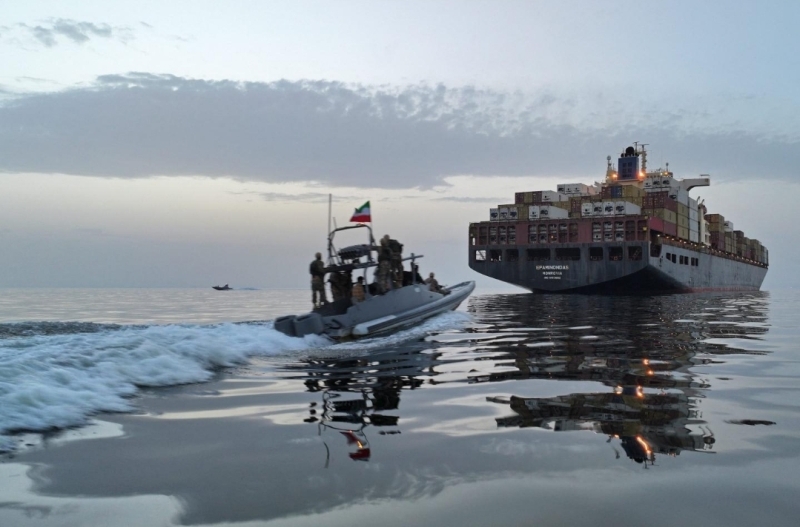
Image: Collected
Iran’s Revolutionary Guards (IRGC) said on Monday that navigational aid systems in the southern Strait of Hormuz had been destroyed and that no unauthorised vessels crossed the route overnight, according to Iranian state media. The claim, which has not been independently verified, signals a further tightening of Iranian control over the strategically vital waterway.
What the IRGC said
An unnamed IRGC Navy official told the Fars News Agency that the destruction of “enemy navigational aid systems” on the southern rocks of the strait had stopped what Iran described as an illegal passage. “No offending vessel was able to enter the illegal passage last night, and the flow of oil smuggling through this corridor was completely stopped,” the official said.
Iranian state broadcaster Press TV carried the same account, saying no unauthorised ships had navigated the passage after the systems were destroyed. The report did not identify when the systems were damaged, what caused the destruction, or which IRGC unit was involved.
A narrower claim
The statement does not say that all shipping through the Strait of Hormuz has stopped. It refers specifically to vessels using the southern route that Iran regards as unauthorised, leaving open the possibility that other traffic continued through approved channels.
Reuters reported the claim but noted that it had not been independently confirmed. The official also did not provide evidence of the damage or specify how many ships, if any, had attempted the route.
Rising tensions
The announcement follows a week of maritime incidents around the strait, including reported tanker strikes and fires near Oman’s Musandam coast. Iran has repeatedly accused the United States of trying to open alternative shipping lanes, while Washington and its partners have pushed for freedom of navigation through the waterway.
IRGC spokesman Brigadier General Hossein Mohebbi separately rejected US President Donald Trump’s assertion that American forces control the strait, saying it remained “completely closed” and that no mines had been removed. Earlier, an adviser to the IRGC commander-in-chief warned that Iran would block channels it said had been opened by blasting rocks in the strait.
Why it matters
The Strait of Hormuz is a critical artery for global energy shipments, and any disruption to navigation or insurance-linked shipping routes can sharply raise freight and oil-market risks. Iran says ships may transit only through routes coordinated with its armed forces, while Iraq has said it resumed exports through a lane near Oman after understandings with Washington and Tehran.
Independent tracking cited in reporting has indicated that daily crossings have fallen well below 2025 levels, though the latest IRGC claim concerns only the southern, unauthorised corridor rather than the entire strait.