

- Zelenskyy warns Starshield limits are hindering drone interceptions |
- Govt considers revamping school food distribution system |
- Service tenure expiry leads to retirement of five BAF officers |
- HSC supplementary exams scheduled to begin on December 1 |
- US ambassador meets Indian High Commissioner amid political uncertainty |
Iran war ‘effectively over’ militarily: Trump says after meeting Qatar PM
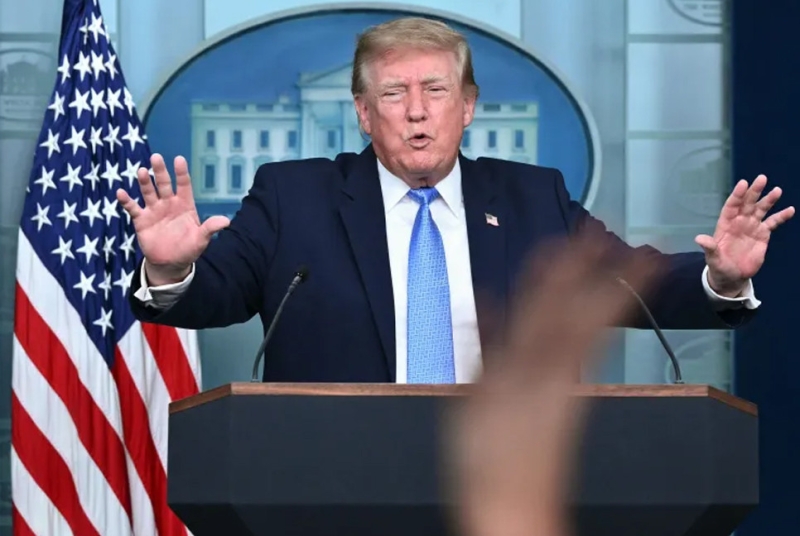
Photo: collected
United States President Donald Trump has said that he considers the US-Israel war on Iran “effectively” at an end, after meeting Qatar’s prime minister in Washington, DC, reports Al Jazeera.
In a surprise briefing on Monday, Trump reiterated his position that the US had destroyed Iran’s military. But his remarks suggested he faces pressure from allies in the Middle East to bring hostilities to a close.
“Iran militarily is effectively over,” he said. “We’re just keeping it the status quo, and we’re doing that really at the behest of countries that are their neighbours.”
His comments followed a closed-door meeting with US Vice President JD Vance and Qatari Prime Minister Sheikh Mohammed bin Abdulrahman bin Jassim Al Thani, who hailed the progress in a post on social media.
“We discussed the situation in the region and ways to progress the US-Iran talks,” the prime minister said. “Grateful for the positive discussions on reaching a deal and bringing peace to the region.”
Still, Trump acknowledged the “status quo” would involve continuing the US naval blockade against Iranian ports, as well as the newly announced Task Force Iron Gate, which seeks to cut off trade by land and through the Caspian Sea.
“Qatar, Saudi Arabia, UAE, Bahrain, Kuwait and others would prefer the status quo, that we remain as is,” he said. “In other words, a continuation of the greatest naval blockade in the history of our country. Probably in the history of the world.”
Trump also indicated in his briefing that the US was willing to resume fighting, should the need arise.
“Taking military action doesn’t seem to be a very necessary thing, but we’re locked and loaded, ready to go for any reason that changes,” he said.
“Israel and the entire Middle East are protected from Iranian danger and threats, and we’re seeing momentum toward the end of this conflict. I think it’s going to be ending fairly soon.”
Iranian officials, meanwhile, dismissed Trump’s latest remarks as a distraction.
“The war on Iran has already wrecked the US government. But Washington flails like a desperate gambler,” Iran’s Supreme National Security Council Secretary Mohsen Rezaei wrote in a post on social media.
“FOLD YOUR HAND. STOP manufacturing FAKE NEWS about imaginary talks.”
Separately, Iran’s President Masoud Pezeshkian said that the country’s Supreme Leader Mojtaba Khamenei had called for an end to the situation, which he described as “neither war nor peace”.
Pezeshkian added that Iran was open to further negotiations but would not be coerced, according to Iranian media. “We will not surrender to force and bullying,” he said.
Since the war on Iran began on February 28, the conflict has spilled into surrounding countries and roiled international trade.
Almost as soon as the US and Israel began their attacks, Iran moved to shut down the Strait of Hormuz, a vital waterway for oil, gas and fertiliser, among other goods.
Iran also responded to US and Israeli strikes with missile and drone fire on its neighbours in the Gulf, including Qatar, Bahrain, Kuwait and the UAE, with many of the attacks targeting US military installations.
Other, related conflicts have since emerged. Saudi Arabia has renewed its fight against the Iran-backed Houthis, and Israel began its occupation of southern Lebanon, as well as deadly air strikes.
In the nearly nine months since the war began, the US offensive against Iran has grown sporadic, with intermittent exchanges of fire.
In recent days, for instance, the Trump administration announced “minor strikes” against Iran’s Qeshm Island.
It also offered a $20m reward for “information about Iran’s nuclear program, including its facilities, equipment, and associated personnel”.
After the Twelve-Day War in June 2025, Trump had claimed that Iran’s uranium enrichment programme had been obliterated. But he has since made curtailing Iran’s nuclear programme a central premise for the ongoing war.
Iran has long denied seeking a nuclear weapon, maintaining its uranium enrichment programme is for the purposes of civilian energy generation.