

- Zelenskyy warns Starshield limits are hindering drone interceptions |
- Govt considers revamping school food distribution system |
- Service tenure expiry leads to retirement of five BAF officers |
- HSC supplementary exams scheduled to begin on December 1 |
- US ambassador meets Indian High Commissioner amid political uncertainty |
No IMF condition behind fuel price hike: Dr Zahed
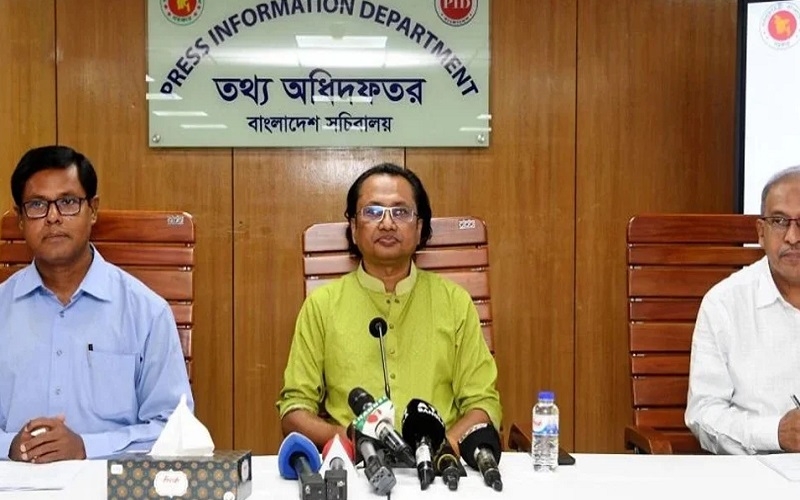
photo: collected
Prime Minister’s Adviser on Information and Broadcasting Dr Zahed Ur Rahman said The International Monetary Fund (IMF) has no condition requiring Bangladesh to raise fuel prices,.
He made the remarks while responding to a question from journalists at a press briefing on the progress of various government ministries and current issues at the Press Information Department (PID) conference room at the Secretariat on Tuesday.
Asked about the fuel price hike, Dr Zahed said there was no such condition from the IMF.
Acknowledging that the fuel price hike would cause hardship for the people, he sought their “kindness” and tolerance towards the government at this time.
He said fuel prices on the global market had declined by 2-3% over the past two to three days, but crude oil prices were still above $100 a barrel.
Although the current high prices were unlikely to persist for long, he said there was a risk that the global energy situation could worsen further.
Explaining the rationale behind the fuel price hike, Dr Zahed said the government was having to provide substantial subsidies to the energy sector amid volatility in the global market. The adjustment of fuel prices was therefore aimed at reducing the pressure of subsidies.
“People are suffering and will suffer because of the increase in fuel prices. We seek their tolerance. Because how much subsidy can the government afford to provide?” he said.
He said that a Tk20 increase in the price of fuel per litre could reduce the government’s annual subsidy burden by around Tk10,000 crore.